In a 24-week, independent, triple-blind randomised trial of 32 people with androgenetic alopecia, a tonic combining biochanin A, acetyl-tetrapeptide-3 and ginseng raised terminal hair count 8.3%, against 8.7% for 3% minoxidil, with no statistically significant difference between the two arms (Lueangarun & Panchaprateep, J Clin Aesthet Dermatol 2020). Androgenetic alopecia, the hereditary thinning known in men as male pattern baldness, is the most common form of hair loss, and it is one of the most thoroughly studied conditions in dermatology. The follicle biology is settled, and so is the line between what a cosmetic can do and what it cannot.
What happens inside the follicle
The follicles do not die. Those genetically sensitive to dihydrotestosterone (DHT), a derivative of testosterone, change how they grow. DHT binds to receptors in these follicles and, over many cycles, signals them to shrink, a process called miniaturisation. Each hair grows in a cycle: a long growing phase, a brief transition, a resting phase, then it sheds and a new hair begins. In DHT-sensitive follicles the growing phase shortens with each successive cycle and the follicle itself gets smaller, so thick, pigmented hairs are replaced by finer, shorter ones. This is established dermatology, not a product claim, and it is why the first sign is lost density rather than a bald patch: the hairs are still growing, just getting smaller each time.
The actives with receipts for density
Two botanically derived approaches have been measured head-to-head against minoxidil, the standard topical drug, in people who had androgenetic alopecia.
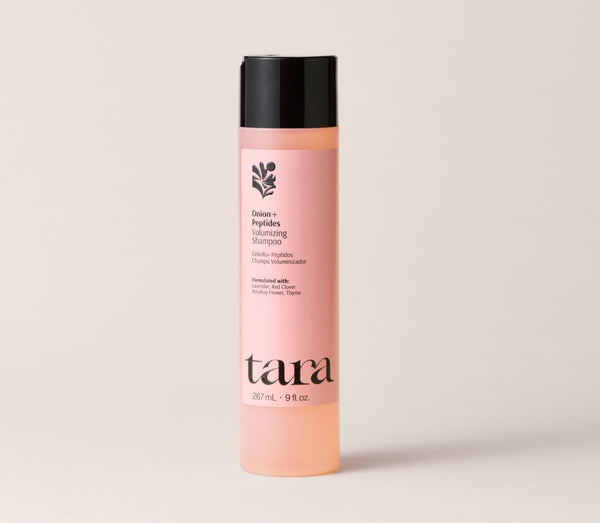
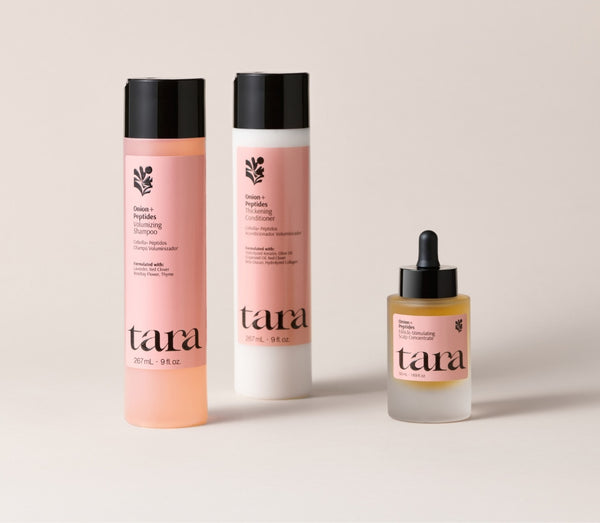
The first is the peptide combination above. Researchers at two Thai universities ran a 24-week, prospective, triple-blind trial in which 32 people, 16 men and 16 women, applied either the herbal tonic or 3% minoxidil. The load-bearing molecule is biochanin A, a red-clover isoflavone that inhibits the type-2 isoform of 5-alpha-reductase, the enzyme that makes DHT in the scalp follicle (Hiipakka et al., Biochem Pharmacol 2002). At 24 weeks both arms had increased terminal hair count, the difference between them was not significant, and the herbal arm recorded no adverse events. It is one trial of 32 people, and non-significance is not the same as proven equivalence, so read it as a strong signal, not a final verdict. In Tara's onion and peptide collection this biochanin-A and acetyl-tetrapeptide-3 load carries the density; the red onion is the identity botanical, not the density active.
The second is rosemary oil. In a six-month randomised trial of 100 men with androgenetic alopecia, topical rosemary oil was compared against 2% minoxidil; both arms significantly increased hair count from baseline, the difference between them was not significant, and the rosemary arm reported significantly less scalp itching (Panahi et al., Skinmed 2015). The trial enrolled 100 men and was single-blind, so it shows rosemary matched a 2% dose in that group, by design, rather than a universal result. Tara's rosemary and peptide range is built on that botanical.
What it does not do
Androgenetic alopecia is permanent. No cosmetic cures it. The genetic sensitivity to DHT does not go away, so sensitive follicles keep miniaturising if the signalling is left unaddressed; any topical effect is maintenance, measured over months, not a reversal. Topical minoxidil and, for men, oral finasteride are the medical options with the deepest evidence; both are a doctor's prescription.
Onion does not treat this condition. The 87% figure everyone shares, in which roughly 87% of patients regrew hair, comes from crude onion juice at close to full strength applied to alopecia areata, an autoimmune condition in which the immune system attacks the follicle (Sharquie & Al-Obaidi, J Dermatol 2002). That is a different disease from hereditary thinning, and the juice used sat orders of magnitude above the bulb extract in any cosmetic, so the regrowth percentage does not transfer to androgenetic alopecia or to a finished product. Onion earns its place as an organosulphur and flavonoid scalp botanical; the density evidence belongs to the peptides.
A scalp-first routine, kept honest
Topical care does not override genetics or replace medical treatment, but the scalp is the environment the remaining follicles grow in, and it is within your control. Keep it clean and balanced with a gentle, sulfate-free wash; apply a lightweight serum to the scalp itself rather than the lengths; handle hair gently to spare fragile, miniaturising strands; and measure progress in months, because that is the pace of the hair cycle. Tara's scalp serums are designed to be left where the follicle lives, and the hair loss hub sets out the wider picture. None of it cures hereditary hair loss; it supports the follicles you still have.
Frequently asked questions
Is androgenetic alopecia the same as male pattern baldness?
Male pattern baldness is androgenetic alopecia as it presents in men, typically a receding hairline and crown thinning. The same condition shows as more diffuse thinning along the parting in women. The underlying mechanism, DHT-sensitive follicles that miniaturise over successive cycles, is identical.
Is there real evidence that anything botanical helps?
Yes, within limits. A biochanin-A, acetyl-tetrapeptide-3 and ginseng tonic raised terminal hair count 8.3% versus 8.7% for 3% minoxidil over 24 weeks, with no significant difference, in an independent triple-blind trial of 32 people with androgenetic alopecia (Lueangarun & Panchaprateep 2020). Separately, rosemary oil matched 2% minoxidil on hair count over six months in 100 men with the condition (Panahi 2015). Both are strong signals, not proof of a cure.
Can hereditary hair loss be reversed or cured?
No cosmetic cures it, because the genetic sensitivity to DHT remains. Minoxidil and, for men, finasteride can slow the loss and partially regrow hair for some people, though the benefit depends on continued use; both are a doctor's prescription.
Does onion treat hereditary hair loss?
No. The much-quoted 87% regrowth figure is from crude onion juice applied to alopecia areata, an autoimmune condition, and at a strength far above any cosmetic extract (Sharquie & Al-Obaidi 2002). That does not transfer to androgenetic alopecia. Onion is a scalp botanical; in a formula the density evidence comes from the peptides, not the onion.
Why is my hair thinning rather than falling out in patches?
Because androgenetic alopecia works through miniaturisation, not sudden loss. Affected follicles shrink and produce finer, shorter hairs over many cycles, so you notice reduced density before any bald areas appear. Sudden or patchy loss usually points to a different cause.
Related: for how common androgenetic alopecia actually is in Saudi Arabia, see the published Saudi data — 45.1% of men, 37.4% of women, every figure cited.