The case for onion rests on one number: in alopecia areata, crude onion juice regrew hair in 20 of 23 against 2 of 15 on tap water, about 87% versus 13% (Sharquie, J Dermatol 2002). The result is real and peer-reviewed. It is also narrower than the headlines, and it says nothing about everyday thinning. Here is what onion, garlic and ginger each do, read against the evidence rather than the folklore.
What the onion study actually tested
The Sharquie trial enrolled people with alopecia areata, a patchy autoimmune loss in which the immune system attacks healthy follicles. Participants rubbed freshly pressed onion juice into the bare patches twice a day; controls used tap water. Over six weeks the onion group regrew far more hair (P below 0.0001). Two facts fix how far that travels. The condition was autoimmune patchy loss, not the hereditary (androgenetic) thinning most people mean. And the intervention was near-neat juice, close to 100% onion by weight, not a measured extract. A striking result, in one specific condition, at a dose no leave-on cosmetic carries.
Onion is a scalp botanical, not the density active
Onion (Allium cepa) is an organosulphur and flavonoid botanical. It is the identity of this collection, not its engine. The popular mechanism, that its quercetin blocks the pattern-thinning enzyme 5-alpha-reductase, fails on inspection: quercetin inhibits the enzyme in a cell-free tube but loses the activity in whole cells (Azizi, F1000Research 2021), so the test-tube finding does not carry into living tissue. The density work in Tara is done by a peptide. A combination of biochanin A and acetyl tetrapeptide-3 raised terminal hair count 8.3% against 8.7% for 3% minoxidil over 24 weeks, with no statistically significant difference between the two, in an independent triple-blind randomised trial of 32 people with androgenetic alopecia, 16 men and 16 women (Lueangarun & Panchaprateep, J Clin Aesthet Dermatol 2020). The load-bearing molecule is biochanin A, a red-clover isoflavone that inhibits the scalp-dominant type-2 5-alpha-reductase (Hiipakka, Biochem Pharmacol 2002). Onion sits alongside that peptide as the scalp botanical; it is not what matched the drug.
Where garlic and ginger fall
Garlic shares onion's sulphur chemistry and turns up in the same patchy-loss literature, but only as an add-on to a medical treatment. Alone it is weak; the stand-alone evidence is thin. Ginger is worse. Its principal compound, 6-gingerol, suppresses hair growth in laboratory work rather than promoting it, so the popular reputation runs backwards. In Tara's formulas ginger appears only as a trace microcirculation note at 0.0075%, far below anything that carries a hair claim, and fermented black garlic earns its place as an antioxidant ferment, not a growth active. Of the three kitchen ingredients, onion holds the only human regrowth signal, and even that belongs to a different condition.
What it does not do
Onion does not regrow hair at a cosmetic dose, and the 87% figure cannot be transplanted onto general thinning. That number is crude juice, close to 100% by weight, applied to autoimmune alopecia-areata patches for a few weeks (Sharquie, J Dermatol 2002); a leave-on extract sits orders of magnitude below it, and androgenetic thinning is a mechanism the study never tested. The quercetin-to-5-alpha-reductase explanation does not hold in living cells (Azizi, F1000Research 2021). Garlic is a weak add-on with no stand-alone proof, and ginger's 6-gingerol may work against growth. The position is plain: onion is a scalp botanical worth its place for its sulphur and flavonoid chemistry, while measured density is the peptide's job, not the bulb's. If your shedding is sudden, patchy or spreading, see a doctor; alopecia areata and similar causes are treatable and worth identifying early.
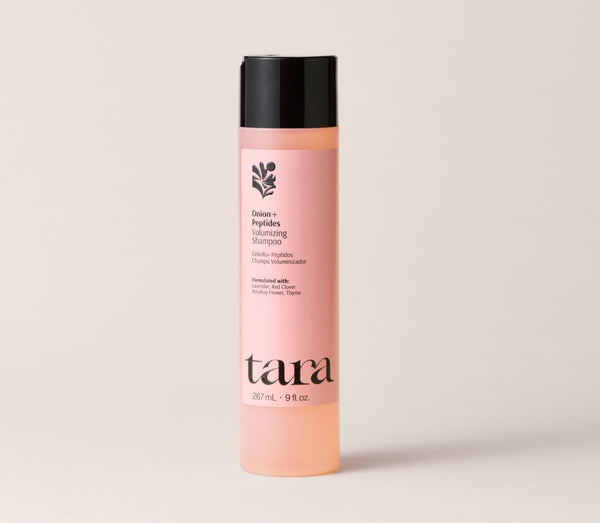
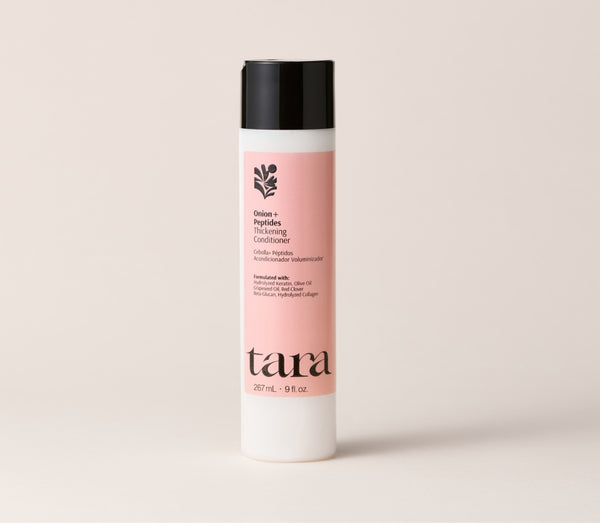
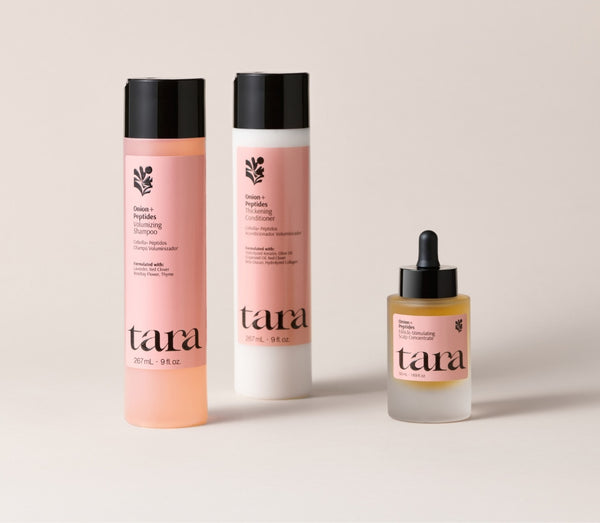
For onion on its own terms, read our closer look at onion for hair. The collection that pairs red onion with the biochanin-A peptide is the Onion Peptides range, and if breakage is also a concern, the black garlic and ceramide line leads on a ceramide that binds damaged hair rather than on garlic itself. Whichever route you take, understand what is driving your hair loss first.
Frequently asked questions
Does onion regrow hair?
Not at a cosmetic dose. One human result supports it, and it is narrow: crude onion juice regrew hair in about 87% of people with alopecia areata, a patchy autoimmune condition, against 13% on tap water (Sharquie, J Dermatol 2002). That was near-neat juice over a few weeks, not a measured cosmetic dose, and it does not transfer to hereditary thinning. Onion is a scalp botanical, not a regrowth treatment.
Does onion juice work for pattern hair loss?
No. The onion study tested alopecia areata, an autoimmune patchy loss, not androgenetic (pattern) thinning, which has a different mechanism. The popular idea that onion's quercetin blocks the pattern-loss enzyme fails: quercetin inhibits 5-alpha-reductase in a cell-free tube but loses that activity in whole cells (Azizi, F1000Research 2021).
What actually carries the density claim, if not onion?
A peptide. A biochanin-A and acetyl-tetrapeptide-3 combination raised terminal hair count 8.3% against 8.7% for 3% minoxidil over 24 weeks, with no significant difference between them, in an independent triple-blind trial of 32 people with androgenetic alopecia (Lueangarun & Panchaprateep, J Clin Aesthet Dermatol 2020). Biochanin A inhibits the scalp-dominant type-2 5-alpha-reductase (Hiipakka, Biochem Pharmacol 2002). Onion is the collection's botanical identity, not the measured active.
Are garlic or ginger as good as onion for hair?
No. Garlic shares onion's sulphur chemistry and appears only as an add-on to medical treatment for patchy loss, with little stand-alone evidence. Ginger is worse: its main compound, 6-gingerol, suppressed hair growth in laboratory studies rather than promoting it. Of the three, only onion has a human regrowth signal, and that belongs to alopecia areata, not general thinning.
Should I use raw onion juice on my scalp?
You can, but set expectations by the evidence. The regrowth signal is specific to autoimmune patchy loss, the juice stings and reddens a sensitive scalp, and the smell is hard to rinse out, so few people keep up the twice-daily routine the study required. If your shedding is sudden, patchy or worsening, a doctor's review beats a kitchen remedy, since the underlying cause is often treatable.
Related: the onion verdict sits beside eleven others in Tara’s evidence table, each with its study and its un-claim.