Oils are not a reliable dandruff treatment. Tea tree is the single oil with real human evidence behind it, and even that is one trial: a 5 percent tea tree shampoo beat placebo on dandruff over four weeks in 126 people (Satchell, J Am Acad Dermatol 2002). Everything else marketed for dandruff runs on lab hints or anecdote, and the heaviest oils make flaking worse. The reason is a yeast called Malassezia.
The one trial worth knowing
In the Satchell study, 126 people with mild-to-moderate dandruff used a 5 percent tea tree oil shampoo or a matching placebo daily for four weeks. The tea tree arm improved dandruff scores by about 41 percent against roughly 11 percent for placebo, a significant difference, and was well tolerated (Satchell, J Am Acad Dermatol 2002). Terpinen-4-ol, tea tree's main component, is antifungal against Malassezia in the lab. That is the ceiling for the entire category: one controlled trial, at a defined dose, in a rinse-off shampoo. No other oil clears that bar.
Every other oil is weak or anecdotal
Dandruff is driven by Malassezia, a lipophilic yeast that lives on almost everyone's scalp and feeds on the fatty parts of sebum; when it overgrows, the skin inflames and shedding speeds up. The oils that do anything act against the yeast, not the ones that merely moisturise. Tea tree is the only one with a controlled human trial. Rosemary and peppermint show antimicrobial and anti-inflammatory activity in lab studies and may soothe an irritated scalp, but there are no dandruff trials. Neem and lemongrass show antifungal activity against Malassezia in early lab work only. Strip away tea tree and the case for oils is mechanism and anecdote, not measured outcomes.
Heavy oils feed dandruff
This is the part most articles bury. Malassezia eats lipids, the fatty acids in sebum and in many plant oils, and the popular hair oils are rich in exactly the fats the yeast burns as fuel. Leave a heavy oil on an already oily, flake-prone scalp and you feed the yeast and worsen flaking. Coconut oil is the clearest case: it conditions hair well, but on a dandruff-prone scalp its fatty-acid profile feeds Malassezia rather than starving it, and olive oil sits in the same camp. Oiling is the wrong instinct for oily-scalp dandruff. The scalp needs less yeast and less build-up, not more oil.
Clarifying beats oiling
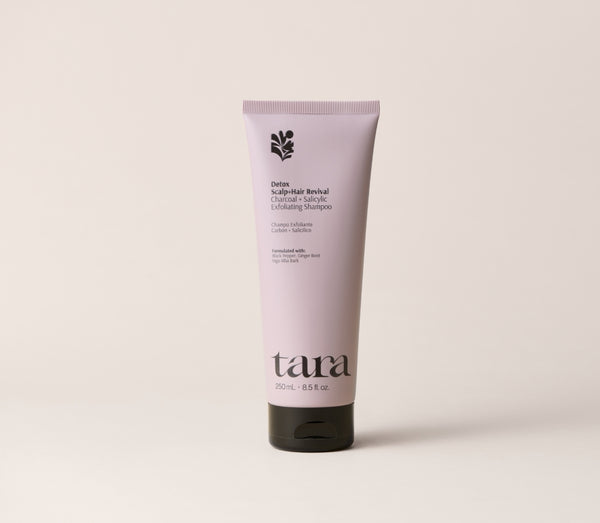
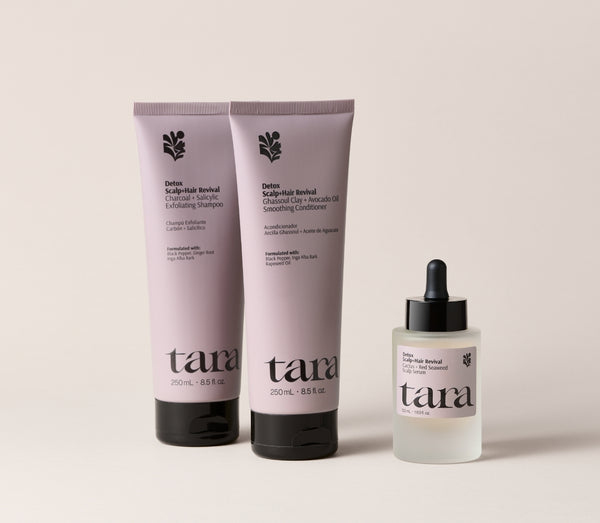
For an oily, flake-prone scalp, remove the oil and build-up instead of adding more: that strips the yeast of its fuel and clears the debris trapping the follicle. This is the approach TARA takes, and the detox shampoo is a clarifier, not an anti-dandruff drug. It ships salicylic acid at 0.4 percent with ghassoul, a lacustrine stevensite clay that adsorbs surface sebum, plus activated charcoal; at that dose the salicylic acid lifts and exfoliates the oil-and-keratin build-up around the follicle. The scalp detox guide shows how a reset wash fits a weekly rhythm, and our piece on what causes dandruff and what works covers what actually controls flakes. To try tea tree anyway, dilute it, keep contact to a few minutes, and give any routine three to four weeks.
What it does not do
Oils are not a reliable dandruff treatment, and several make it worse. Only tea tree has a controlled trial (Satchell, J Am Acad Dermatol 2002); the rest rest on lab hints or anecdote, and heavy lipid-rich oils such as coconut and olive feed Malassezia on an oily scalp and increase flaking. If oiling has not helped, more oil is not the answer. TARA's detox shampoo is a build-up clarifier, not an anti-dandruff product, and we do not present it as one: salicylic acid at 0.4 percent sits below the 1.8 percent the US FDA recognises for dandruff control (Monograph M032, 2021), so the only verb the dose supports is that it lifts build-up. Charcoal does not detox the follicle: an independent dermatology review found no clinical evidence for charcoal's cosmetic claims (Sanchez et al., Clin Dermatol 2020), and cosmetic charcoal particles are too large to enter it (Patzelt et al., J Control Release 2011); charcoal binds oil on the surface and rinses away. Persistent, inflamed, or thickly scaling flakes, or flaking with hair loss, need a dermatologist.
Frequently asked questions
Do oils for dandruff actually work?
Mostly no. Tea tree is the one exception with a controlled trial: a 5 percent tea tree shampoo beat placebo on dandruff over four weeks (Satchell, J Am Acad Dermatol 2002). Every other oil rests on lab hints or anecdote, and heavy oils feed the Malassezia yeast and worsen flaking on an oily scalp. For an oily, flake-prone scalp, clearing oil and build-up beats adding more.
Is tea tree oil for dandruff the best option?
Among oils, yes, because it is the only one with human evidence. A 5 percent tea tree oil shampoo improved dandruff scores by about 41 percent versus 11 percent for placebo (Satchell, J Am Acad Dermatol 2002), and its main compound is antifungal against Malassezia in the lab. Dilute it and keep contact short; undiluted tea tree can irritate or sensitise.
Can coconut or olive oil make dandruff worse?
On a dandruff-prone scalp, yes. Malassezia feeds on the fatty acids in many plant oils, and coconut and olive oil are rich in them. Leaving a heavy oil on an oily, flaky scalp gives the yeast more fuel and increases flaking. A light antifungal applied briefly, or simply clarifying the scalp, is the safer choice.
Does a salicylic acid shampoo like TARA's detox treat dandruff?
No, and we do not claim it does. The detox shampoo ships salicylic acid at 0.4 percent, below the 1.8 percent the US FDA recognises for dandruff control (Monograph M032, 2021). At that dose it is a clarifier: it lifts and exfoliates the build-up that traps the follicle, but it is not a medicated anti-dandruff treatment. For persistent dandruff, use a medicated antifungal or see a dermatologist.
What are the best natural remedies for dandruff?
Diluted tea tree oil is the natural remedy with the most evidence (Satchell, J Am Acad Dermatol 2002). Beyond that one oil, the most useful natural step is clearing oil and build-up rather than oiling, since that removes the yeast's fuel; a clarifying wash with salicylic acid, clay and charcoal fits that goal. Stubborn flaking still usually needs a medicated antifungal, and inflamed or persistent flaking warrants a dermatologist.