Dandruff is the most misread scalp problem, and the misreading costs you. People see flakes, assume the scalp is dry, and reach for heavier oils that make it worse. The cause runs the other way: an oily scalp and a yeast that thrives on that oil. Get the cause right and you treat the source instead of chasing the symptom.
What causes dandruff
Classic dandruff, and its more inflamed relative seborrheic dermatitis, comes down to three things acting together.
- Malassezia yeast. A microbe that lives on almost everyone's scalp. It feeds on the oils the skin produces and releases by-products that irritate susceptible scalps.
- Excess sebum, an oily scalp. The more oil the scalp makes, the more this yeast has to feed on, so flaking and oiliness travel together.
- Individual sensitivity. Not everyone reacts to the same yeast. Some scalps tolerate it quietly; others answer with redness, itching and the visible shedding we call dandruff.
This is why dandruff is so common and so recurrent. The aim is not to eliminate the yeast, which is neither realistic nor desirable, but to control the oil it feeds on and the scalp's reaction to it.
Oily scalp versus dry scalp: the distinction people get wrong
This is the one thing to get right, because it changes what you do. The two look alike from across the mirror and behave differently up close.
- Dandruff on an oily scalp. Flakes are larger, yellowish and greasy, and cling to the scalp or sit in the hair near the roots. The scalp turns oily again within a day or two of washing.
- A genuinely dry scalp. Flakes are smaller, white and powdery, and the skin feels tight rather than greasy, often alongside dryness elsewhere or in cold, low-humidity weather.
The error is treating oily-scalp dandruff as dryness. Piling on heavy oils feeds the yeast and adds to build-up, so the flaking returns. A truly dry scalp benefits from gentle hydration, but that is the less common cause of persistent dandruff.
Other causes worth ruling out
A few everyday factors worsen flaking without being the root cause. Product build-up from styling residue, silicones and infrequent washing congests the scalp and traps oil at the root. Washing too little lets oil and yeast accumulate; harsh, too-frequent washing irritates the barrier and provokes more flaking. Stress, heat and sweat do not cause dandruff, but they trigger flare-ups, which matters in a hot, humid climate.
What controls dandruff, once you know the cause
Dandruff is yeast-driven, so the treatments with the strongest evidence act on the yeast or the over-shedding directly. Antifungals such as ketoconazole, zinc pyrithione and selenium sulfide target Malassezia itself. Salicylic acid earns a place too, but only at the right dose: the US FDA recognises it for dandruff control at 1.8 to 3 percent in rinse-off shampoos (OTC Monograph M032, 2021). In one controlled trial, 3 percent salicylic acid with ciclopirox matched prescription ketoconazole 2 percent on dandruff scores at day 29, though that reflects the combination, not salicylic acid alone (Squire & Goode, J Dermatolog Treat 2002; industry-supported, disclosed). Persistent redness with greasy scale signals seborrheic dermatitis; thick, silvery plaques signal scalp psoriasis. See a dermatologist if flaking is severe, spreading, or comes with hair loss. The step-by-step routine lives in our guide to salicylic acid for dandruff and scalp itch.
Where a clarifying wash fits
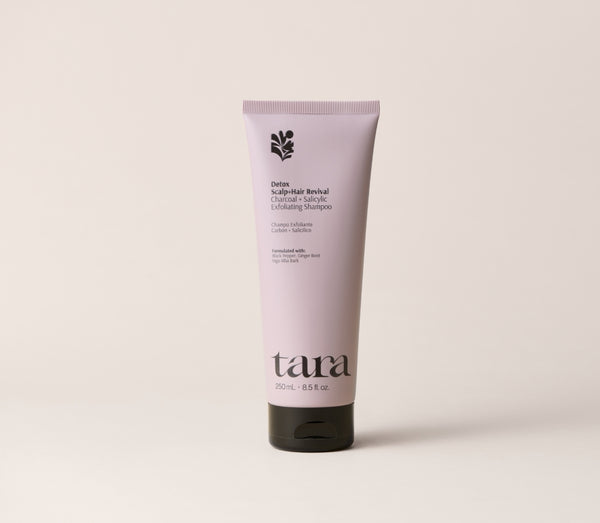
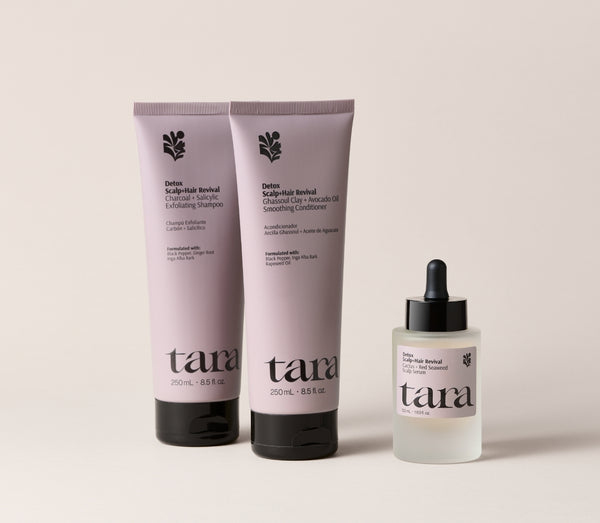
For the far more common oily, flaky scalp, a regular reset clears the build-up the yeast feeds on. It sits before medicated treatment, not in place of it. A clarifying, scalp-focused wash loosens dead skin and clears the oil-and-keratin plug at the root, so an oily scalp feels genuinely clean. TARA's detox shampoo is built for this: it lifts oil and residue gently, without stripping the scalp so hard that it rebounds with more oil. Ghassoul, a lacustrine stevensite clay, adsorbs surface sebum during the wash. Our scalp detox guide shows how to fit a reset into a normal week.
What it does not do
Two things, stated plainly. First, a clarifier is not a dandruff treatment. TARA's detox shampoo ships salicylic acid at 0.4 percent, well below the 1.8 percent the US FDA recognises for dandruff control (Monograph M032, 2021), so it does not control dandruff and we do not present it as one. At 0.4 percent, salicylic acid lifts and exfoliates build-up. That is the verb the evidence supports, and the only one we use; the yeast itself needs an antifungal.
Second, activated charcoal does not detox the follicle or draw toxins from the scalp. An independent dermatology review found no clinical evidence for charcoal's cosmetic claims (Sanchez et al., Clin Dermatol 2020), and cosmetic charcoal particles are one to two orders of magnitude too large to enter the follicle (Patzelt et al., J Control Release 2011). Charcoal binds oil on the surface during the wash and rinses away: it is the sensory signal of a deep cleanse, not the active.
Frequently asked questions
What are the main causes of dandruff?
Three things together: Malassezia yeast that naturally lives on the scalp, excess oil (sebum) that feeds it, and an individual sensitivity that turns that into redness, itching and flaking. Product build-up, infrequent washing, stress and heat worsen it, but the yeast-plus-oil combination is the core cause.
Is dandruff caused by a dry scalp or an oily scalp?
An oily scalp, which surprises people. Classic dandruff is driven by excess oil that feeds scalp yeast, and the flakes are larger, yellowish and greasy. A genuinely dry scalp gives smaller, powdery white flakes and tight skin, and is the less common cause of persistent dandruff.
How can I tell if my scalp is oily or dry?
Notice how your scalp feels a day or two after washing and what the flakes look like. Oily scalps turn greasy quickly and shed larger, slightly yellow flakes that cling near the roots. Dry scalps feel tight, with fine, white, powdery flakes, often alongside dryness elsewhere on the body.
Does a clarifying or detox shampoo treat dandruff?
No. A clarifier lifts oil and build-up, which helps an oily, flake-prone scalp feel clean, but it does not act on the yeast that drives dandruff. The US FDA recognises salicylic acid for dandruff control at 1.8 to 3 percent (Monograph M032, 2021); TARA's detox shampoo ships it at 0.4 percent, so it is a clarifier, not an anti-dandruff treatment. For dandruff itself, use a medicated antifungal.
Will adding oil to my scalp help with dandruff?
Not if your scalp is oily. Heavy oils give scalp yeast more to feed on and add to the build-up that worsens flaking. Gentle hydration helps a genuinely dry, tight scalp, but for the common oily, flaky type a clarifying wash that reduces oil and residue is the better step.