Onion does not regrow hair at the dose you would put in a shampoo. The famous 87% comes from one place: a 2002 study where crude onion juice, near full strength, was rubbed twice daily into the bare patches of alopecia areata — an autoimmune disease, not the gradual thinning most people mean by hair loss. Twenty of 23 people regrew hair, against 2 of 15 on tap water (Sharquie, J Dermatol 2002). That single figure is why onion juice refuses to die as a remedy. It is also why the honest version of the story is far narrower than the headline.
What the onion-juice study measured
Sharquie and Al-Obaidi recruited people with alopecia areata, a patchy loss in which the immune system attacks the follicle. One group rubbed crude onion juice into the bare patches twice a day; a control group used tap water. At six weeks, 87% of the onion group showed regrowth against 13% of the controls (Sharquie, J Dermatol 2002). The gap was large and statistically clear. That is what makes the number stick — and what makes it so easy to misread.
Three facts pin it down. It was controlled but not randomised or blinded, so it is a strong signal, not settled proof. It tested alopecia areata, an autoimmune condition, not androgenetic (pattern) thinning — the result does not transfer to the loss most people are searching about. And the intervention was raw juice at roughly full strength, applied directly to skin twice daily: a concentration and routine no cosmetic extract comes close to reproducing.
What onion actually is
Onion is an organosulphur and flavonoid scalp botanical. That is the whole of it. The most-repeated mechanistic claim — that its quercetin blocks 5-alpha-reductase, the enzyme behind pattern hair loss — is false in any setting that counts. Quercetin inhibits 5-alpha-reductase in a cell-free assay and loses that activity in whole cells (Azizi, F1000Research 2021). In living cells, where the enzyme actually does its work, the effect disappears. The tidy enzyme story is a test-tube artefact, not a mechanism onion brings to a scalp. Onion is what it is; it does not get to borrow a mode of action it fails in cells.
What it does not do
Onion does not regrow hair at the dose a serum carries, and it does not treat hereditary thinning. The 87% is the receipt for crude juice on an autoimmune disease (Sharquie, J Dermatol 2002), not for a cosmetic-dose bulb extract that sits orders of magnitude lower — the percentage does not transfer to a formulated product, and anyone who implies it does is selling the study, not the bottle. The quercetin-and-5-alpha-reductase mechanism is falsified in whole cells (Azizi, F1000Research 2021). Measurable density has a receipt, but it belongs to the peptide, not the onion: a biochanin-A and acetyl-tetrapeptide-3 tonic raised terminal hair count 8.3% against 8.7% for 3% minoxidil over 24 weeks, with no significant difference between the two arms, in an independent triple-blind trial of 32 people with androgenetic alopecia, men and women by design (Lueangarun & Panchaprateep, J Clin Aesthet Dermatol 2020). Onion is the identity botanical; biochanin A carries the density. Raw juice also brings its own costs: a strong, lingering smell, stinging on a sensitive scalp, and a strength that changes with every batch and degrades once cut.
A more consistent way to use onion
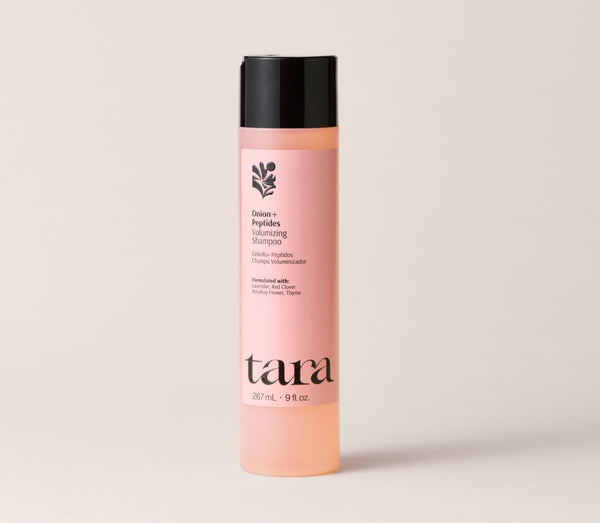
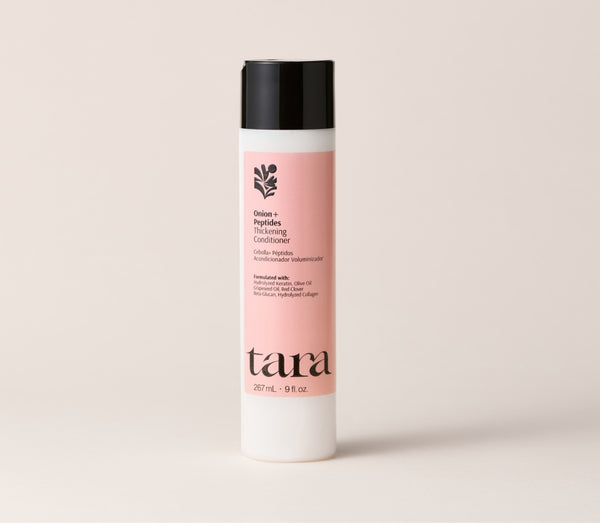
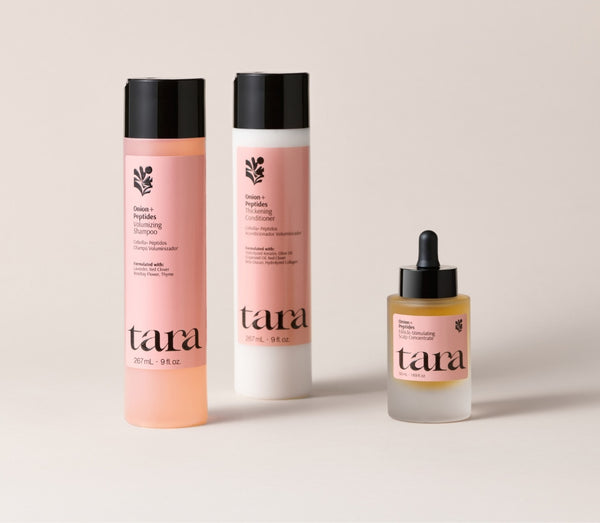
The appeal of onion is the botanical, not the smell or the guesswork. A formulated approach keeps the first and drops the rest. Tara pairs a standardised red onion (Allium cepa) extract — the line's identity botanical — with the biochanin-A and acetyl-tetrapeptide-3 peptide complex that carries the density receipt, in a leave-on scalp format at a fixed strength. You can see the red onion and peptide range. The follicle lives in the scalp, so a leave-on serum does this job better than a rinse-out juice that varies batch to batch.
If you are weighing onion against the other kitchen botanicals, our look at onion, garlic and ginger for hair loss sets them side by side. Whatever you try, work out what is driving your hair loss first, because the right ingredient depends on the cause. Sudden, patchy, or worsening shedding is a job for a doctor, not a home remedy.
Frequently asked questions
Does onion juice regrow hair?
Not at any dose you would put in a product, and not for hereditary thinning. In one controlled study, crude onion juice applied twice daily regrew hair in 20 of 23 people with alopecia areata, against 2 of 15 on tap water (Sharquie, J Dermatol 2002). That was an autoimmune condition and near-full-strength juice — a strong signal for that setting, not evidence that onion regrows pattern thinning, and not transferable to a cosmetic-dose extract.
Does the 87% regrowth figure apply to a red onion serum?
No. The 87% comes from crude onion juice at roughly 100% strength on alopecia-areata lesions (Sharquie, J Dermatol 2002). A formulated extract sits orders of magnitude below that, so the percentage cannot be carried over to a serum. In Tara's range the density receipt belongs to the peptide, not the onion.
Does onion's quercetin block DHT and stop hair loss?
No. Quercetin inhibits 5-alpha-reductase, the enzyme behind pattern loss, in a cell-free assay, then loses that activity in whole cells (Azizi, F1000Research 2021). In living cells the effect is gone, so the quercetin-and-DHT explanation for onion is falsified where it would have to work. Onion is an organosulphur and flavonoid botanical, nothing more.
What actually carries the density claim, if not onion?
The peptide. A biochanin-A and acetyl-tetrapeptide-3 tonic raised terminal hair count 8.3% against 8.7% for 3% minoxidil over 24 weeks, with no significant difference between arms, in an independent triple-blind trial of 32 people with androgenetic alopecia (Lueangarun & Panchaprateep, J Clin Aesthet Dermatol 2020). Onion is the identity botanical; biochanin A is the load-bearing molecule for density.
Is a red onion serum better than raw onion juice?
Yes. Raw juice smells strongly, stings a sensitive scalp, varies in strength batch to batch, and degrades once cut. A standardised serum delivers the red onion botanical at a fixed strength and pairs it with the peptide complex that carries the density receipt (Lueangarun & Panchaprateep, J Clin Aesthet Dermatol 2020), which makes a steady scalp routine far easier to keep up.